Contributors
Links
- SOGWAP.NET home page
- Shari's Isaiah62 web site
- Michael's Weblog
- Miller Family web site
- Get Well Naturally
Archives
Dedicated to God and His Word.
Shari's Isaiah 62 Web Site | Main SOGWAP - Home Page | Our Efax 707-276-3970
Wednesday, March 31, 2004
dear Michael,
I am in Tiberias area of the Sea of Galilee.
Yesterday, we went to Cesarea, saw the amphitheatre, mansions of Herod ruins, the ruins of the 2nd largest port in the world at that time, built by Herod, the Hippodrome and the mediterranean sea right there. Historians think that the Apostle Paul was under house arrest at Herod's mansions there; if so, it would have been a really comfortable imprisonment!
Ceasarea was a real pagan center, something like San Francisco, and God poured out Salvation to the Gentiles right there in Ceasarea for the first time!
What mercy and grace of God!
Then we went to Mt. Carmel, where Elijah confronted the 450 prophets of Baal, who were on Jezebele's payroll. Art Katz spoke the Word of the Lord from this location, and prayed a powerful prayer and I felt like the "fire of God" came pouring down on us---I could hardly move!
Then we went to the Basilica of the Annunciation, Nazereth, where the Angel of the Lord announced the good news of the conception for the birth of Jesus that would ensue.
This is very likely, the location, because historical evidence from relatives of Jesus are historically documented for 200 years after his death, and point to that place; and also Christian pilgrims have been coming there since 200 years after his death and leaving graffitti, like Mary lived here, and hail Mary!, etc.
Then we drove thru Cana of the Galilee, where Jesus turned the water into wine at the wedding feast.
It was a real spiritually powerful day!
Today, 03/31/04
Here's our schedule:
IT WAS FULL!
We started out in the morning and went to Korazin, where Jesus said, "woe! to you Korazin, if the works were done in Sadom and Gemorrah that were done in you, they would have repented long ago!"
Jesus "hung out" in Capernaum, Korazin and Bethsaida, as a regular place of testimony and fellowship, and the people there regularly enjoyed his teachings and anointing, and were blessed with him, but weren't willing to personally repent and change their lifestyle and surrender their lifes to the Lord!
They enjoyed the anointing, but weren't willing to pay the price!
We had a rollacking biblical debate between the tour guide and Art in reference to Jewish thought towards God and true Christian belief/action toward God...
in other words, the walk of faith by the spirit vs. works...the discussion went into the most incredible detail, I have ever experienced--definately, delivering experience!
Mark Koch is recording these invaluable gems/jewels that are being said/released into the environment and is going to give me a copy of it all when we get home!
Then we went to the Mt. of Beatitudes, where Jesus gave the sermon on the mount. Art Katz compared it to Moses delivery on Mt Sinai---we'll release a copy of it the near future! He said Jesus was totally dependent on God, and opened up His mouth and God filled it and he spoke!
Then we went to Tabgha, where Peter reconciled with the Lord after His resurrection! It was incredible, spiritually, there.
Again, the rock where the locals testified that it took place, and historically documented. Then a church was built and evolved over the ages, surrounding it, to protect it. Art shared on Peter, if you REALLY love me, you'll:
1) tend my sheep---take good care of my people besides feeding them my word.
2) feed my lambs--take care of my immature new babes in the Lord!
3) feed my sheep---much more than than just preach my word---receive nurishment and the fullness behind the word given by my spirit!
There is much more to this in understanding than I previously had!
Then we had lunch at an Arab Christian restaurant at the sea of Galilee, and the spirit of prophesy rose up in me and I prophesied to the waiter, a moslem
and the Lord gave me a Word to speak to him and he received it wide-eyed and very humbly and before God, he bowed. It really touched my heart, incredibly!
Then we went to Capernaum, where Peter lived and Jesus spent most of his time.
It was an incredible excavation uncovered---actually Peter's home, and surrounding area.
Then we went for a boat ride from Capernaum across to Kibbutz Kinneret, where the 2000 year old ancient boat from the 1st century, exactly around Jesus' time was discovered, when in a drought time about 10+ years ago, on the shores of the Galilee sea.
IT WAS ANOTHER AWESOME DAY! Filled with Prophesy, articulate right dividing of God's word (that will be shared in depth in the near future, upon
my return home!) and the eyes of understanding constantly being enlightened; delivered with grace and power; and bringing healing, deliverance, and greater commitment to the Lord!
I am in Tiberias area of the Sea of Galilee.
Yesterday, we went to Cesarea, saw the amphitheatre, mansions of Herod ruins, the ruins of the 2nd largest port in the world at that time, built by Herod, the Hippodrome and the mediterranean sea right there. Historians think that the Apostle Paul was under house arrest at Herod's mansions there; if so, it would have been a really comfortable imprisonment!
Ceasarea was a real pagan center, something like San Francisco, and God poured out Salvation to the Gentiles right there in Ceasarea for the first time!
What mercy and grace of God!
Then we went to Mt. Carmel, where Elijah confronted the 450 prophets of Baal, who were on Jezebele's payroll. Art Katz spoke the Word of the Lord from this location, and prayed a powerful prayer and I felt like the "fire of God" came pouring down on us---I could hardly move!
Then we went to the Basilica of the Annunciation, Nazereth, where the Angel of the Lord announced the good news of the conception for the birth of Jesus that would ensue.
This is very likely, the location, because historical evidence from relatives of Jesus are historically documented for 200 years after his death, and point to that place; and also Christian pilgrims have been coming there since 200 years after his death and leaving graffitti, like Mary lived here, and hail Mary!, etc.
Then we drove thru Cana of the Galilee, where Jesus turned the water into wine at the wedding feast.
It was a real spiritually powerful day!
Today, 03/31/04
Here's our schedule:
IT WAS FULL!
We started out in the morning and went to Korazin, where Jesus said, "woe! to you Korazin, if the works were done in Sadom and Gemorrah that were done in you, they would have repented long ago!"
Jesus "hung out" in Capernaum, Korazin and Bethsaida, as a regular place of testimony and fellowship, and the people there regularly enjoyed his teachings and anointing, and were blessed with him, but weren't willing to personally repent and change their lifestyle and surrender their lifes to the Lord!
They enjoyed the anointing, but weren't willing to pay the price!
We had a rollacking biblical debate between the tour guide and Art in reference to Jewish thought towards God and true Christian belief/action toward God...
in other words, the walk of faith by the spirit vs. works...the discussion went into the most incredible detail, I have ever experienced--definately, delivering experience!
Mark Koch is recording these invaluable gems/jewels that are being said/released into the environment and is going to give me a copy of it all when we get home!
Then we went to the Mt. of Beatitudes, where Jesus gave the sermon on the mount. Art Katz compared it to Moses delivery on Mt Sinai---we'll release a copy of it the near future! He said Jesus was totally dependent on God, and opened up His mouth and God filled it and he spoke!
Then we went to Tabgha, where Peter reconciled with the Lord after His resurrection! It was incredible, spiritually, there.
Again, the rock where the locals testified that it took place, and historically documented. Then a church was built and evolved over the ages, surrounding it, to protect it. Art shared on Peter, if you REALLY love me, you'll:
1) tend my sheep---take good care of my people besides feeding them my word.
2) feed my lambs--take care of my immature new babes in the Lord!
3) feed my sheep---much more than than just preach my word---receive nurishment and the fullness behind the word given by my spirit!
There is much more to this in understanding than I previously had!
Then we had lunch at an Arab Christian restaurant at the sea of Galilee, and the spirit of prophesy rose up in me and I prophesied to the waiter, a moslem
and the Lord gave me a Word to speak to him and he received it wide-eyed and very humbly and before God, he bowed. It really touched my heart, incredibly!
Then we went to Capernaum, where Peter lived and Jesus spent most of his time.
It was an incredible excavation uncovered---actually Peter's home, and surrounding area.
Then we went for a boat ride from Capernaum across to Kibbutz Kinneret, where the 2000 year old ancient boat from the 1st century, exactly around Jesus' time was discovered, when in a drought time about 10+ years ago, on the shores of the Galilee sea.
IT WAS ANOTHER AWESOME DAY! Filled with Prophesy, articulate right dividing of God's word (that will be shared in depth in the near future, upon
my return home!) and the eyes of understanding constantly being enlightened; delivered with grace and power; and bringing healing, deliverance, and greater commitment to the Lord!
Tuesday, March 30, 2004
Here is another three page fax from Shari, click on links to view pages:
69087124-1.jpg
69087124-2.jpg
69087124-3.jpg
69087124-1.jpg

69087124-2.jpg

69087124-3.jpg
Sunday, March 28, 2004
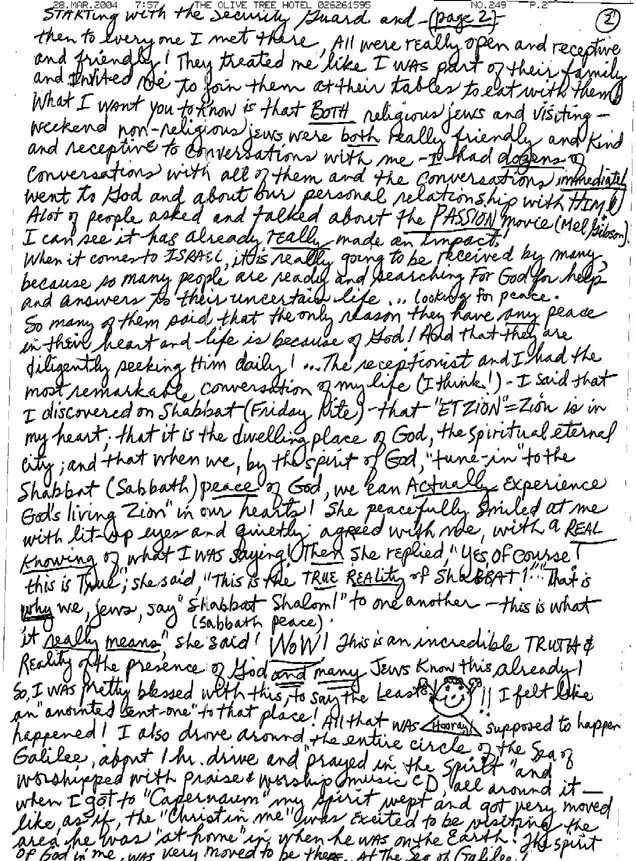
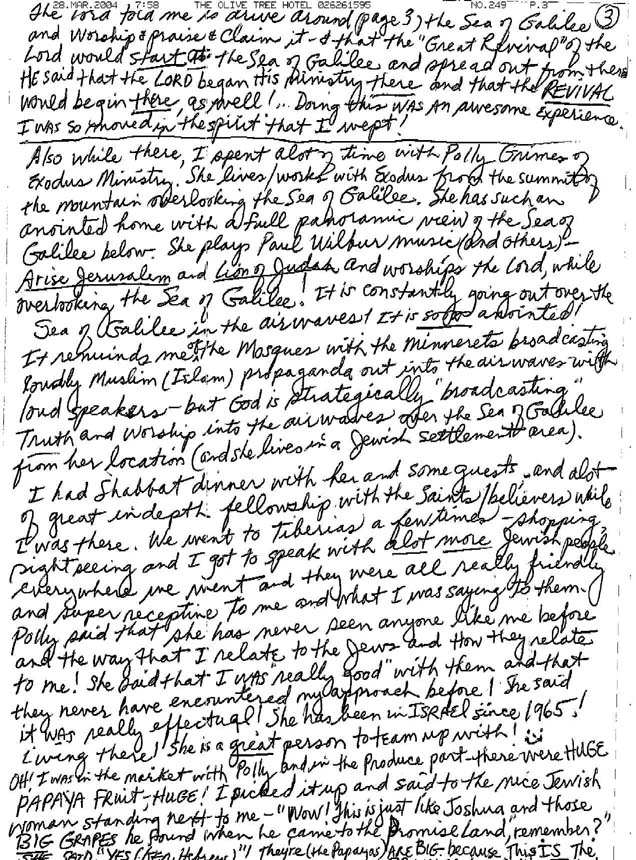
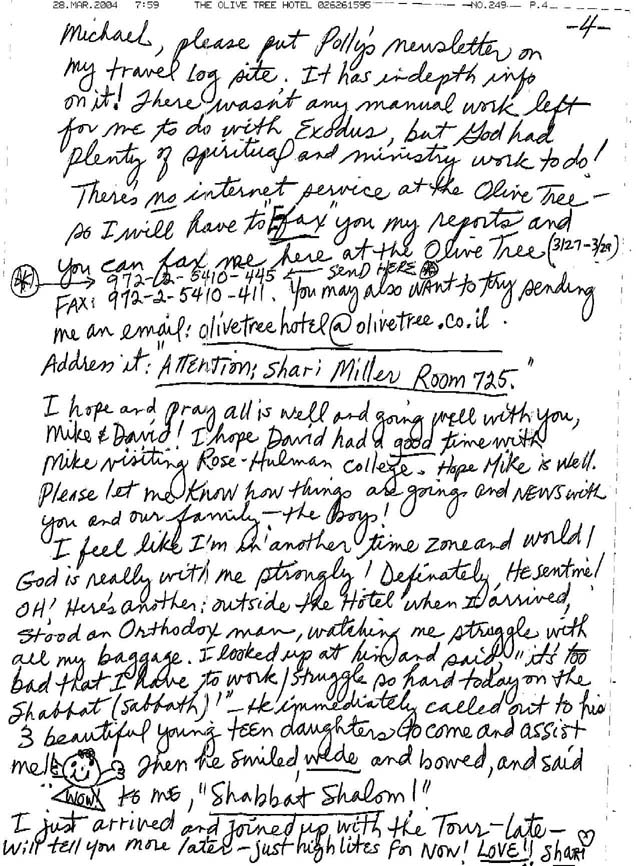
I just received this four page fax from Shari, click on links to view pages:
666a26200001.jpg
666a26200002.jpg
666a26200003.jpg
666a26200004.jpg
Note, the correct email address: olivetree@olivetreehotel.co.il
Shari Recommends: Polly's newsletter
666a26200001.jpg

666a26200002.jpg
666a26200003.jpg
666a26200004.jpg
Note, the correct email address: olivetree@olivetreehotel.co.il
Shari Recommends: Polly's newsletter
Monday, March 22, 2004
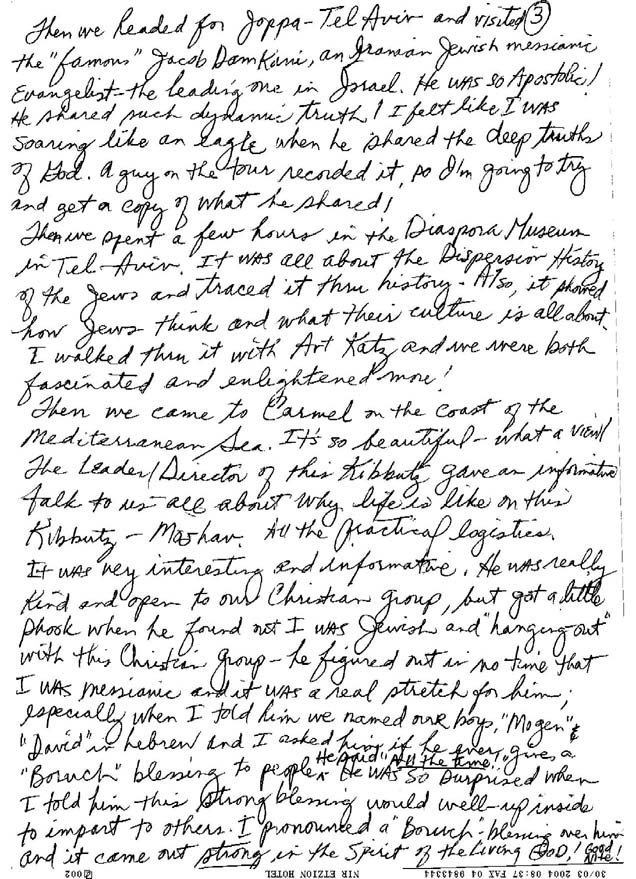
SHALOM!
On the www.sogwap.net website, Michael added the purpose and vision of the Israel trip separate, as well as, Tour Schedule separate, Links separate, and The daily Weblog separate.
The reason for this is so it won't be one looong entry!
I want to encourage you to take a good look at the purpose and vision of this trip to Israel; then carefully read over the tour schedule. The bold highlighted words are the key places to be visited on this trip...these places correspond to the preliminary information already prepared for you.
To give you a head start/ background of what and where we are going to visit!
Please note that the links page are carefully chosen pages of supplemental, further in depth information
and teachings about the key sites to be visited. By reading the supplemental links, I gained a much greater understanding of the whole picture of Israel, which included it's many dimensions and facets becoming much clearer to me!
I hope you enjoy our trip!
LOVE,
Shari
On the www.sogwap.net website, Michael added the purpose and vision of the Israel trip separate, as well as, Tour Schedule separate, Links separate, and The daily Weblog separate.
The reason for this is so it won't be one looong entry!
I want to encourage you to take a good look at the purpose and vision of this trip to Israel; then carefully read over the tour schedule. The bold highlighted words are the key places to be visited on this trip...these places correspond to the preliminary information already prepared for you.
To give you a head start/ background of what and where we are going to visit!
Please note that the links page are carefully chosen pages of supplemental, further in depth information
and teachings about the key sites to be visited. By reading the supplemental links, I gained a much greater understanding of the whole picture of Israel, which included it's many dimensions and facets becoming much clearer to me!
I hope you enjoy our trip!
LOVE,
Shari
The Mount Of Olives
If Jesus Christ had favorite places during His earthly life, the Mount of Olives was certainly one of them. He spent much time there.
The 2 mile (3½ kilometers) long Mount of Olives is a flattened ridge series located just a few hundred yards (meters) east of the Temple Mount in Jerusalem. It rises over 200 feet (60 meters) above the Kidron Valley which separates those two very significant places.
The Mount of Olives was the place where numerous events of Bible History occurred. Many of the most important people of the Bible walked upon it sooner or later.
The Old Testament
King David fled over the Mount of Olives to escape from Absalom's rebellion (2 Samuel 15:30). After King Solomon became corrupt, he built pagan "high places" there (1 Kings 11:7). Later, King Josiah destroyed Solomon's idolatrous altars, by which time it had become known as the Hill of Corruption (2 Kings 23:13-14). Ezekiel had his vision of The Lord and the flying cherubim above it (Ezekiel 11:22-23). The people gathered olive branches there for the first Feast of Tabernacles after their return from The Babylonian Exile (Nehemiah 8:15).
The New Testament
Jesus regularly went up onto the Mount of Olives (Luke 22:39). He often traveled over it on His way to Bethany to visit His friend Lazarus. His famous Olivet prophecy is named after it (Matthew 24:1-51). The Triumphal Entry of Jesus riding on a Donkey and her colt into Jerusalem took place over and down the Mount of Olives (Luke 19:28-44). Jesus prayed with His disciples there just before His arrest That Fateful Night (Luke 22:39-46). Jesus was arrested there, during which Peter struck the servant of the high priest with a sword and cut off his ear (Luke 22:49-51). Jesus appeared to the disciples on the Mount of Olives after His Resurrection, and He ascended into heaven from there (Acts 1:1-12).
The Mount of Olives In The Future
"After He said this, He was taken up before their very eyes, and a cloud hid Him from their sight. They were looking intently up into the sky as He was going, when suddenly two men dressed in white stood beside them. 'Men of Galilee,' they said, 'why do you stand here looking into the sky? This same Jesus, Who has been taken from you into heaven, will come back in the same way you have seen Him go into heaven.'" (Acts 1:9-11) (see The Return Of Jesus Christ)
"At that time the sign of The Son of Man will appear in the sky (see Signs In The Heavens), and all the nations of the earth will mourn. They will see The Son of Man coming on the clouds of the sky, with power and great glory. And He will send His angels with a loud trumpet call and they will gather His elect from the four winds, from one end of the heavens to the other." (Matthew 24:30-31)
"Then The Lord will go out and fight against those nations, as He fights in the day of battle. On that day His feet will stand on the Mount of Olives, east of Jerusalem, and the Mount of Olives will be split in two (see Earthquake!) from east to west, forming a great valley, with half of the mountain moving north and half moving south. You will flee by my mountain valley, for it will extend to Azel. You will flee as you fled from the earthquake in the days of Uzziah king of Judah. Then The Lord my God will come, and all the holy ones with Him. (Zechariah 14:3-5)
Fact Finder: During the Olivet prophecy, did Jesus Christ warn us that prior to His Return there would be many false "Christs" and false prophets in the world?
Matthew 24:4-5, 23-25
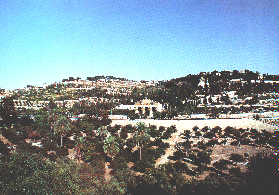


If Jesus Christ had favorite places during His earthly life, the Mount of Olives was certainly one of them. He spent much time there.
The 2 mile (3½ kilometers) long Mount of Olives is a flattened ridge series located just a few hundred yards (meters) east of the Temple Mount in Jerusalem. It rises over 200 feet (60 meters) above the Kidron Valley which separates those two very significant places.
The Mount of Olives was the place where numerous events of Bible History occurred. Many of the most important people of the Bible walked upon it sooner or later.
The Old Testament
King David fled over the Mount of Olives to escape from Absalom's rebellion (2 Samuel 15:30). After King Solomon became corrupt, he built pagan "high places" there (1 Kings 11:7). Later, King Josiah destroyed Solomon's idolatrous altars, by which time it had become known as the Hill of Corruption (2 Kings 23:13-14). Ezekiel had his vision of The Lord and the flying cherubim above it (Ezekiel 11:22-23). The people gathered olive branches there for the first Feast of Tabernacles after their return from The Babylonian Exile (Nehemiah 8:15).
The New Testament
Jesus regularly went up onto the Mount of Olives (Luke 22:39). He often traveled over it on His way to Bethany to visit His friend Lazarus. His famous Olivet prophecy is named after it (Matthew 24:1-51). The Triumphal Entry of Jesus riding on a Donkey and her colt into Jerusalem took place over and down the Mount of Olives (Luke 19:28-44). Jesus prayed with His disciples there just before His arrest That Fateful Night (Luke 22:39-46). Jesus was arrested there, during which Peter struck the servant of the high priest with a sword and cut off his ear (Luke 22:49-51). Jesus appeared to the disciples on the Mount of Olives after His Resurrection, and He ascended into heaven from there (Acts 1:1-12).
The Mount of Olives In The Future
"After He said this, He was taken up before their very eyes, and a cloud hid Him from their sight. They were looking intently up into the sky as He was going, when suddenly two men dressed in white stood beside them. 'Men of Galilee,' they said, 'why do you stand here looking into the sky? This same Jesus, Who has been taken from you into heaven, will come back in the same way you have seen Him go into heaven.'" (Acts 1:9-11) (see The Return Of Jesus Christ)
"At that time the sign of The Son of Man will appear in the sky (see Signs In The Heavens), and all the nations of the earth will mourn. They will see The Son of Man coming on the clouds of the sky, with power and great glory. And He will send His angels with a loud trumpet call and they will gather His elect from the four winds, from one end of the heavens to the other." (Matthew 24:30-31)
"Then The Lord will go out and fight against those nations, as He fights in the day of battle. On that day His feet will stand on the Mount of Olives, east of Jerusalem, and the Mount of Olives will be split in two (see Earthquake!) from east to west, forming a great valley, with half of the mountain moving north and half moving south. You will flee by my mountain valley, for it will extend to Azel. You will flee as you fled from the earthquake in the days of Uzziah king of Judah. Then The Lord my God will come, and all the holy ones with Him. (Zechariah 14:3-5)
Fact Finder: During the Olivet prophecy, did Jesus Christ warn us that prior to His Return there would be many false "Christs" and false prophets in the world?
Matthew 24:4-5, 23-25
Please see the website for the Yad Vashem museum at:
http://www.yad-vashem.org.il/
http://www.yad-vashem.org.il/
Temple Mount
From Kidron Valley
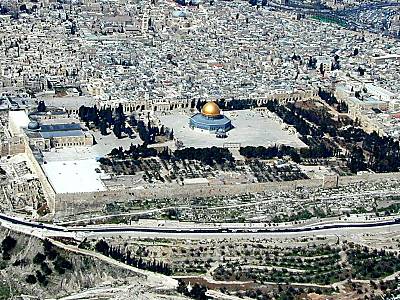
Often visitors wonder why the Temple Mount isn't the highest point in the city when the Bible seems to describe it as such. The answer is that the city today (including the "Old City") has grown and shifted from its original location. The earliest city of Jerusalem is the "City of David," a smaller hill south of, and lower than, the Temple Mount.
Aerial from East
The present Temple Mount was constructed by Herod the Great beginning in 20 B.C. Construction on it continued for 83 years until 64 A.D. when a halt was called to the project and 18,000 workers were laid off (riots resulted). The Temple Mount is 1/6 the size of today's Old City and covers 35 acres. Construction of this rectangular platform required filling in a large part of the Central Valley.
Aerial from East
From Kidron Valley
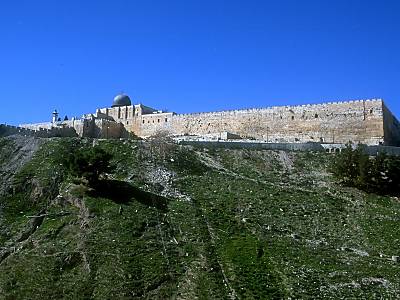
From Kidron Valley
Often visitors wonder why the Temple Mount isn't the highest point in the city when the Bible seems to describe it as such. The answer is that the city today (including the "Old City") has grown and shifted from its original location. The earliest city of Jerusalem is the "City of David," a smaller hill south of, and lower than, the Temple Mount.
Aerial from East
The present Temple Mount was constructed by Herod the Great beginning in 20 B.C. Construction on it continued for 83 years until 64 A.D. when a halt was called to the project and 18,000 workers were laid off (riots resulted). The Temple Mount is 1/6 the size of today's Old City and covers 35 acres. Construction of this rectangular platform required filling in a large part of the Central Valley.
Aerial from East
From Kidron Valley
Banias-Cesarea Phillipi
Banias’s first inhabitants were probably the Greek Seleucids who conquered the region in 198 B.C. With its constant flowing waters, caves and cliffs below the majestic Hermon Mountain, Banias was so impressive that the Seleucids apparently endowed the Banias with supernatural powers. It is likely that the scenery around Banias reminded them of home, for they imported stories about Pan the pagan god of nature - to the cliff and Banias spring. In fact, scholars believe the ancients held that the half-goat, half-man god resided within the cave!
Five niches hewn in the rock are remnants of a temple built to Pan. An inscription at the base of one of the niches refers to Pan as a "lover of the tunes" as he was famous for his reed flute. Banias was originally called Panias in his honor. Its current name is a local corruption of the letter P.
After Panias came under Roman rule, King Herod built a magnificent white temple at the site. Following Herod's death his son Herod Phillip established Panias as his capital city and called it Caesarea Philippi to distinguish it from Caesarea on the coast. Hundreds of years later Crusaders added a great fortified wall to Caesarea Philippi, which was the site of numerous battles between Christians and Moslems during the Crusader era.
It was near Caesarea Philippi, the center of pagan worship, that Jesus traveled with His disciples to examine their understanding of who He was. Here Peter proclaimed his identity. Jesus responded, "On this rock I will build my church, and the gates of Hades will not overcome it" [Matthew 16:18].


Mount of the Beatitudes Country
The land at the northwest corner of the Sea of Galilee rises from 700 feet below sea level to more than 200 feet above sea level in a conical shape that forms a natural amphitheater. This area has traditionally been identified as the hillside where Jesus preached the Sermon on the Mount.
One day as the crowds were gathering, Jesus went up the hillside with his disciples and sat down to teach them. Enormous crowds were following Him. Everyone wanted to see him. When Jesus began teaching he surprised the people because he taught about kingdom values with eternal consequences. He spoke with authority. His teachings were not multiple choice options but a holistic teaching that identified the journey towards Christ likeness.
See the location of the Sermon on the Mount---watch in real video at: http://www.virtualtravels.com/diary/israel99/17mountbeatitudes.html


The land at the northwest corner of the Sea of Galilee rises from 700 feet below sea level to more than 200 feet above sea level in a conical shape that forms a natural amphitheater. This area has traditionally been identified as the hillside where Jesus preached the Sermon on the Mount.
One day as the crowds were gathering, Jesus went up the hillside with his disciples and sat down to teach them. Enormous crowds were following Him. Everyone wanted to see him. When Jesus began teaching he surprised the people because he taught about kingdom values with eternal consequences. He spoke with authority. His teachings were not multiple choice options but a holistic teaching that identified the journey towards Christ likeness.
See the location of the Sermon on the Mount---watch in real video at: http://www.virtualtravels.com/diary/israel99/17mountbeatitudes.html
Sunday, March 21, 2004
Tabgha: Church of the Multiplication of the Loaves and the Fishes
Christians of the early Byzantine period built monastries, churches and shrines in Galilee and on the
shores of the Sea of Galilee to commemorate the ministry of Jesus and the miracles ascribed to him. Tabgha – an Arabic corruption of the Greek name Heptapegon (Seven Springs) – is the traditional site of the Miracle of the Multiplication of the Loaves and the Fishes. (Matt. 14: 13-21) It is situated in a narrow, fertile valley on the northern shore of the lake, watered by several springs.
The earliest building at Tabgha was a small chapel (18 x 9.6 m) from the 4th century CE; only a part of its foundations was uncovered. This was probably the shrine described by the pilgrim Egeria at the end of the 4th century:
In the same place (not far from Capernaum) facing the Sea of Galilee is a well watered land in which lush grasses grow, with numerous trees and palms. Nearby are seven springs which provide abundant water. In this fruitful garden Jesus fed five thousand people with five loaves of bread and two fish. The stone upon which the Master placed the bread became an altar. The many pilgrims to the site broke off pieces of it as a cure for their ailments.
The monastery and church at Tabgha were destroyed in the 7th century, probably during the Arab conquest of the country, and buried beneath a thick layer of silt and stones. In the 1980s, after excavation, the church was restored to its Byzantine form, incorporating portions of the original mosaics.
The church is famous for its mosaics, unique among Byzantine churches in the Holy Land. Most of the floor of the church is decorated in ordinary geometric patterns. The unique principal mosaics decorate both sides of the transept. Particularly well preserved is the one on the left of the platform, a square carpet (6.5 x 5.5 m.) bordered with a band of lotus flowers.
During the fifth century, a large monastery and a church decorated with exquisite mosaic floors was built on the site. The complex covered an area of 56 x 33 m. and included courtyards and many rooms used as workshops for a variety of crafts as well as for lodging for the monks and the many pilgrims who came to visit.
nilometer.bmp
A tower marked with bands bearing Greek letters, probably for measuring the water level of the Sea of Galilee (known as a "nilometer"), is also depicted.
untitled.bmp
Christians of the early Byzantine period built monastries, churches and shrines in Galilee and on the
shores of the Sea of Galilee to commemorate the ministry of Jesus and the miracles ascribed to him. Tabgha – an Arabic corruption of the Greek name Heptapegon (Seven Springs) – is the traditional site of the Miracle of the Multiplication of the Loaves and the Fishes. (Matt. 14: 13-21) It is situated in a narrow, fertile valley on the northern shore of the lake, watered by several springs.
The earliest building at Tabgha was a small chapel (18 x 9.6 m) from the 4th century CE; only a part of its foundations was uncovered. This was probably the shrine described by the pilgrim Egeria at the end of the 4th century:
In the same place (not far from Capernaum) facing the Sea of Galilee is a well watered land in which lush grasses grow, with numerous trees and palms. Nearby are seven springs which provide abundant water. In this fruitful garden Jesus fed five thousand people with five loaves of bread and two fish. The stone upon which the Master placed the bread became an altar. The many pilgrims to the site broke off pieces of it as a cure for their ailments.
The monastery and church at Tabgha were destroyed in the 7th century, probably during the Arab conquest of the country, and buried beneath a thick layer of silt and stones. In the 1980s, after excavation, the church was restored to its Byzantine form, incorporating portions of the original mosaics.
The church is famous for its mosaics, unique among Byzantine churches in the Holy Land. Most of the floor of the church is decorated in ordinary geometric patterns. The unique principal mosaics decorate both sides of the transept. Particularly well preserved is the one on the left of the platform, a square carpet (6.5 x 5.5 m.) bordered with a band of lotus flowers.
During the fifth century, a large monastery and a church decorated with exquisite mosaic floors was built on the site. The complex covered an area of 56 x 33 m. and included courtyards and many rooms used as workshops for a variety of crafts as well as for lodging for the monks and the many pilgrims who came to visit.
nilometer.bmp
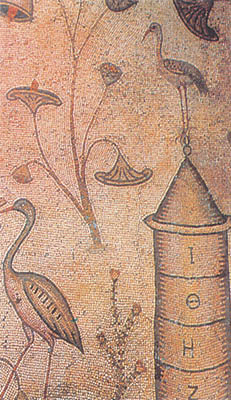
A tower marked with bands bearing Greek letters, probably for measuring the water level of the Sea of Galilee (known as a "nilometer"), is also depicted.
untitled.bmp

Capernaum, The City Of Jesus
by David Padfield
The city of Capernaum was built on the northern shore of the Sea of Galilee, about two miles west of the Jordan River. Though this ancient town is not mentioned by name in the Old Testament, it is referred to as our Lord's "own city" (Matt. 9:1), for it became the center of His Galilean work and ministry.
Early in his account of the gospel, Matthew points out that Jesus began His Galilean ministry here in order to fulfill Old Testament prophecy. "And leaving Nazareth, He came and dwelt in Capernaum, which is by the sea, in the regions of Zebulun and Naphtali, that it might be fulfilled which was spoken by Isaiah the prophet, saying: 'The land of Zebulun and the land of Naphtali, the way of the sea, beyond the Jordan, Galilee of the Gentiles: the people who sat in darkness saw a great light, and upon those who sat in the region and shadow of death light has dawned.'" (Matt. 4:13-16).
Prior to His ascension back into heaven, Jesus gave the Great Commission after "eleven disciples went away into Galilee, to the mountain which Jesus had appointed for them" (Matt. 28:16).
Five men from Capernaum (Peter, Andrew, James, John and Matthew) were called by the Lord to be His apostles. Jesus had often stayed in Peter's house in Capernaum and preached in the synagogue there which had been built by a Roman centurion (Luke 7:5).
The city was important enough to have a tax office, over which Matthew had presided (Matt. 9:9). A detachment of Roman soldiers was stationed in the town.
The Way Of The Sea
The greatest roads of the ancient world passed through Galilee. The Via Maris led from Damascus through Galilee down to Egypt. The Road to the East led through Galilee away out to the frontiers. Jesus could not have picked a better city in all of Israel to symbolize the worldwide implications of His redeeming gospel. One writer said, "Judaea is on the way to nowhere: Galilee is on the way to everywhere."


Please see David Padfield's site for further information and more pictures at:
http://www.padfield.com/1998/capern.html
NAZARETH
History
Nazareth was settled from the Middle Bronze Age onwards and silos, cisterns and oil presses show that it has been an agricultural village for several millennia.
Jesus was raised in Nazareth and the Christian religion had its beginnings here. The modern Hebrew word for Christians, ``Notzrim,'' derives from the name of the town. There are numerous references in the New Testament to Nazareth, particularly to Jesus being chased out of the town after claiming to be the Messiah (Luke 4:21).
The Romans devastated Nazareth during the Jewish Revolt. After the collapse of Bar Kochba's rebellion, the city became a Jewish town made up of many refugees from Judaea.
The Byzantines expelled the Jews who had earlier sided with the invading Persians. Nazareth's Christian shrines were definitively located and the first churches were built during Constantine's reign.
The Moslems destroyed the city but the churches were rebuilt by the Crusaders. Nazareth was completely devastated by Sultan Beibars in 1263 and lay desolate for some 400 years. Thereafter the Franciscans returned under the tolerant rule of the Druze ruler, Fakhr al-Din.
Napoleon's troops held it briefly in 1799, when it was reclaimed by the Turks.
Before the outbreak of World War I the Germans established their military headquarters for Palestine in Nazareth. It surrendered to the British in 1918.
The town fell to Israeli troops two months after Independence and was the town with the largest concentration of Arabs in the pre-1967 borders.
Upper Nazareth received its first settlers in 1957, a factor that brought car assembly plants and textile, food and furniture factories to its environs.
The Galilee town of the Annunciation, where Jesus spent much of his youth nestles between rolling hills. Its spiked churches are overshadowed by the charcoal-grey roof of the monumental Basilica of the Annunciation, built over the ruins of churches dating from the 4th century. It is the largest church in the Middle East.
Churches rise over two places believed to be where the Archangel Gabriel informed Mary of the imminent birth of Jesus. Others shelter the home of the carpenter, Joseph, the well from which Mary drew water, and the mount from where Jesus escaped his angry congregation: ``Verily I say unto you, No prophet is accepted in his own country'' (Luke 4:24).
At the 200-year-old Maronite church in the Latin quarter, mass is said in Arabic and Aramaic.
Nazrat Illit (Upper Nazareth)
This new town is on the hills northeast of the old town and is a sterling example of city planners taking aesthetic considerations into account. From a modest beginning with 1,000 settlers in 1957, Nazrat Illit now has a population of more than 34,000. Located 34 km. east of Haifa and 30 km. west of Tiberias, Nazareth overlooks the Jezreel Valley.
Climate: pleasantly cool in summer because it is set in the hills above the valley, and winter is less severe than in Upper Galilee. There are about 58,000 people living in the old city, about half of whom are Moslems and half Christians.
Please see this webshots site that has many good pictures of Nazereth and Galilee at:
http://community.webshots.com/album/73836870aCLLDs/2

open air city bazaar in Nazareth

valley via nazereth
History
Nazareth was settled from the Middle Bronze Age onwards and silos, cisterns and oil presses show that it has been an agricultural village for several millennia.
Jesus was raised in Nazareth and the Christian religion had its beginnings here. The modern Hebrew word for Christians, ``Notzrim,'' derives from the name of the town. There are numerous references in the New Testament to Nazareth, particularly to Jesus being chased out of the town after claiming to be the Messiah (Luke 4:21).
The Romans devastated Nazareth during the Jewish Revolt. After the collapse of Bar Kochba's rebellion, the city became a Jewish town made up of many refugees from Judaea.
The Byzantines expelled the Jews who had earlier sided with the invading Persians. Nazareth's Christian shrines were definitively located and the first churches were built during Constantine's reign.
The Moslems destroyed the city but the churches were rebuilt by the Crusaders. Nazareth was completely devastated by Sultan Beibars in 1263 and lay desolate for some 400 years. Thereafter the Franciscans returned under the tolerant rule of the Druze ruler, Fakhr al-Din.
Napoleon's troops held it briefly in 1799, when it was reclaimed by the Turks.
Before the outbreak of World War I the Germans established their military headquarters for Palestine in Nazareth. It surrendered to the British in 1918.
The town fell to Israeli troops two months after Independence and was the town with the largest concentration of Arabs in the pre-1967 borders.
Upper Nazareth received its first settlers in 1957, a factor that brought car assembly plants and textile, food and furniture factories to its environs.
The Galilee town of the Annunciation, where Jesus spent much of his youth nestles between rolling hills. Its spiked churches are overshadowed by the charcoal-grey roof of the monumental Basilica of the Annunciation, built over the ruins of churches dating from the 4th century. It is the largest church in the Middle East.
Churches rise over two places believed to be where the Archangel Gabriel informed Mary of the imminent birth of Jesus. Others shelter the home of the carpenter, Joseph, the well from which Mary drew water, and the mount from where Jesus escaped his angry congregation: ``Verily I say unto you, No prophet is accepted in his own country'' (Luke 4:24).
At the 200-year-old Maronite church in the Latin quarter, mass is said in Arabic and Aramaic.
Nazrat Illit (Upper Nazareth)
This new town is on the hills northeast of the old town and is a sterling example of city planners taking aesthetic considerations into account. From a modest beginning with 1,000 settlers in 1957, Nazrat Illit now has a population of more than 34,000. Located 34 km. east of Haifa and 30 km. west of Tiberias, Nazareth overlooks the Jezreel Valley.
Climate: pleasantly cool in summer because it is set in the hills above the valley, and winter is less severe than in Upper Galilee. There are about 58,000 people living in the old city, about half of whom are Moslems and half Christians.
Please see this webshots site that has many good pictures of Nazereth and Galilee at:
http://community.webshots.com/album/73836870aCLLDs/2
open air city bazaar in Nazareth
valley via nazereth
Megiddo, Israel
In apocalyptic literature, Mount Megiddo (Hebrew: Har Megiddo), the hill overlooking the valley (Jezreel) where the current kibbutz is located, is identified as the site of the final battle between the forces of good and evil at the end of time, known as Armageddon.
Many battles have taken place near the town of Megiddo, Palestine, but only those during the last three and a half millennia are known.
Megiddo is a tel, a hill made of 26 layers of the ruins of ancient cities in a strategic location at the head of a pass through the Carmel Ridge, which overlooks the Jezreel Valley from the south. Megiddo was a site of great importance in ancient world, as it guarded the western branch of Via Maris, an ancient trade route from Egypt to Mesopotamia.
The site was inhabited from 7000 BC to 500 BC. Modern Megiddo is nearby. The neighboring Mount Megiddo (Har-megiddo in Hebrew), gave its name to the Armageddon of the Christian Bible.
Megiddo--the ruins of which are Tel Megiddo--is an ancient, fortified city near the mouth of the Jezreel Valley in modern-day Israel. Mentioned in at least 6 separate books of the Bible, some historians believe that this city in the Near East was the site of more battles than any other place in history. The citizens of Megiddo, at different times in the city’s history, faced off against the various armies of Assyria, Canaan, Egypt, Greece, Israel, Persia, Philistine, and Rome. Even a decisive battle between English and Ottoman forces occurred near there in World War I.
The city, which was inhabitied continuously from 7000-500 BCE, was no doubt defended and conquered so many times due to its position along antiquity’s major superhighway, the Via Maris. From Megiddo its rulers were able to exert control of an entire region, having only to defend the extremely narrow Aruna pass. With its seemingly endless cycle of conquest and revolt, it is no wonder the ancient Hebrews set the final battle known as "Armageddon" (literally the mount of Megiddo) here.
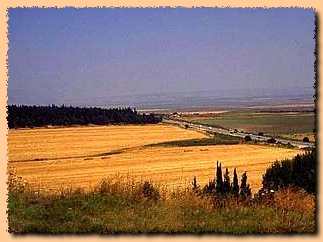
The Jezreel Valley (of "Armagedon")
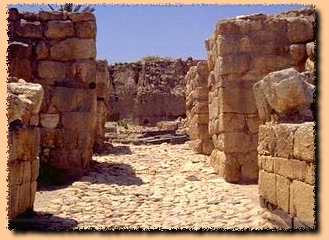
Gates to the city of Megiddo
PLEASE go to this website and view a video tour of tel Megiddo
http://www.virtualtravels.com/diary/israel99/24megiddo.html
In apocalyptic literature, Mount Megiddo (Hebrew: Har Megiddo), the hill overlooking the valley (Jezreel) where the current kibbutz is located, is identified as the site of the final battle between the forces of good and evil at the end of time, known as Armageddon.
Many battles have taken place near the town of Megiddo, Palestine, but only those during the last three and a half millennia are known.
Megiddo is a tel, a hill made of 26 layers of the ruins of ancient cities in a strategic location at the head of a pass through the Carmel Ridge, which overlooks the Jezreel Valley from the south. Megiddo was a site of great importance in ancient world, as it guarded the western branch of Via Maris, an ancient trade route from Egypt to Mesopotamia.
The site was inhabited from 7000 BC to 500 BC. Modern Megiddo is nearby. The neighboring Mount Megiddo (Har-megiddo in Hebrew), gave its name to the Armageddon of the Christian Bible.
Megiddo--the ruins of which are Tel Megiddo--is an ancient, fortified city near the mouth of the Jezreel Valley in modern-day Israel. Mentioned in at least 6 separate books of the Bible, some historians believe that this city in the Near East was the site of more battles than any other place in history. The citizens of Megiddo, at different times in the city’s history, faced off against the various armies of Assyria, Canaan, Egypt, Greece, Israel, Persia, Philistine, and Rome. Even a decisive battle between English and Ottoman forces occurred near there in World War I.
The city, which was inhabitied continuously from 7000-500 BCE, was no doubt defended and conquered so many times due to its position along antiquity’s major superhighway, the Via Maris. From Megiddo its rulers were able to exert control of an entire region, having only to defend the extremely narrow Aruna pass. With its seemingly endless cycle of conquest and revolt, it is no wonder the ancient Hebrews set the final battle known as "Armageddon" (literally the mount of Megiddo) here.
The Jezreel Valley (of "Armagedon")
Gates to the city of Megiddo
PLEASE go to this website and view a video tour of tel Megiddo
http://www.virtualtravels.com/diary/israel99/24megiddo.html
Mt. Carmel
Geographical Significance
Here the southern side of Mt. Carmel near the coast can be seen. Mt. Carmel was most significant in ancient times as a barrier to traffic along the coastal plain. The 1500-foot high limestone mountain impeded armies and merchants traveling to the Jezreel Valley.
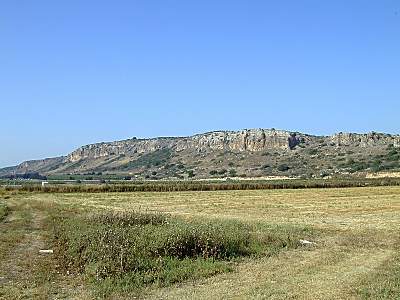

Elijah's Contest
This is probably the best view of the area of Elijah's contest, assuming tradition is correct. The monastery of Muhraqa is at the top of the hill, but tradition places the contest slightly lower near a spring. The crowds of Israelites would have filled the spacious territory around to see whose God would win.

Geographical Significance
Here the southern side of Mt. Carmel near the coast can be seen. Mt. Carmel was most significant in ancient times as a barrier to traffic along the coastal plain. The 1500-foot high limestone mountain impeded armies and merchants traveling to the Jezreel Valley.
Elijah's Contest
This is probably the best view of the area of Elijah's contest, assuming tradition is correct. The monastery of Muhraqa is at the top of the hill, but tradition places the contest slightly lower near a spring. The crowds of Israelites would have filled the spacious territory around to see whose God would win.
CAESAREA
Caesarea was an important port city on the Mediterranean coast of Palestine, 22 miles south of Mt Carmel. The coast of Palestine does not have good natural harbors, so this port city and harbor was built over a twelve year period by Herod the Great (23-13 B.C.). While procurator of Judea, Pontius Pilate lived in the governor's residence in Caesarea.
It was in Caesarea that the centurion Cornelius lived and was converted. After Peter's dream about clean and unclean he responded to Cornelius' call and came to the gentile centurion in Caesarea understanding his vision to mean God's gospel was intended for the gentiles as well.
Paul's 2nd and 3rd missionary journeys began in Caesarea. Paul was sent to stand trial before Felix and was imprisoned there for 2 years before making his defense before Festus and Agrippa and being sent to Rome.
King Herod wanted to build a monument to show his gratitude to his Roman patron, Caesar Augustus. To that end, in the year 10 BC, he launched one of the largest building campaigns ever conducted, turning Caesarea - named after the Roman emperor - into one of the most striking cities in the world of its time.
When the Romans assumed direct control over Judaea in CE 6, Caesarea became not only the capital of the province (a role it played for the next 500 years), but the headquarters for the Roman legions stationed in Judaea. Although it is assumed that Caesarea also served as the official residence of the Roman governor, documentary evidence is lacking prior to the administration of Pontius Pilate (CE 26-36). It was from Caesarea that Pontius Pilate set out for Jerusalem for the Passover festival at which he sentenced Jesus to be crucified.
Caesarea was also prominent in early church history. The first Gentile (the centurion Cornelius) was baptized here by the apostle Peter (Acts 10). The apostle Paul not only passed through Caesarea on several of his journeys (Acts 9:30; 18:22; 21:8-16), but was also imprisoned here by the governors Festus and Felix before going to Rome to appeal his case before Nero (Acts 23:22-26:32).


Note: pic on right is a virtual recreation of King Herod's Maritime Caesarea; see link- http://australis.www2.50megs.com/caesarea/Caesarea.htm
Caesarea was an important port city on the Mediterranean coast of Palestine, 22 miles south of Mt Carmel. The coast of Palestine does not have good natural harbors, so this port city and harbor was built over a twelve year period by Herod the Great (23-13 B.C.). While procurator of Judea, Pontius Pilate lived in the governor's residence in Caesarea.
It was in Caesarea that the centurion Cornelius lived and was converted. After Peter's dream about clean and unclean he responded to Cornelius' call and came to the gentile centurion in Caesarea understanding his vision to mean God's gospel was intended for the gentiles as well.
Paul's 2nd and 3rd missionary journeys began in Caesarea. Paul was sent to stand trial before Felix and was imprisoned there for 2 years before making his defense before Festus and Agrippa and being sent to Rome.
King Herod wanted to build a monument to show his gratitude to his Roman patron, Caesar Augustus. To that end, in the year 10 BC, he launched one of the largest building campaigns ever conducted, turning Caesarea - named after the Roman emperor - into one of the most striking cities in the world of its time.
When the Romans assumed direct control over Judaea in CE 6, Caesarea became not only the capital of the province (a role it played for the next 500 years), but the headquarters for the Roman legions stationed in Judaea. Although it is assumed that Caesarea also served as the official residence of the Roman governor, documentary evidence is lacking prior to the administration of Pontius Pilate (CE 26-36). It was from Caesarea that Pontius Pilate set out for Jerusalem for the Passover festival at which he sentenced Jesus to be crucified.
Caesarea was also prominent in early church history. The first Gentile (the centurion Cornelius) was baptized here by the apostle Peter (Acts 10). The apostle Paul not only passed through Caesarea on several of his journeys (Acts 9:30; 18:22; 21:8-16), but was also imprisoned here by the governors Festus and Felix before going to Rome to appeal his case before Nero (Acts 23:22-26:32).
Note: pic on right is a virtual recreation of King Herod's Maritime Caesarea; see link- http://australis.www2.50megs.com/caesarea/Caesarea.htm
Beth Hatefutsoth (Diaspora Museum)Israel
Phone: 03/646-2020
OVERVIEW of Beth Hatefutsoth (Diaspora Museum)
Presented here are 2,500 years of Jewish life in the Diaspora (the settling of Jews outside Israel), beginning with the destruction of the First Temple in Jerusalem and chronicling such major events as the exile to Babylon and the expulsion from Spain in 1492. Also covered is the world of Eastern Europe before the Holocaust. Photographs and text labels provide the narrative, and films and music enhance the experience. One highlight is a replica collection of miniature synagogues throughout the world, both those destroyed and those still functioning. Another is the computerized genealogy section, where it is possible to look up Jewish family names to determine their origins. (Source: Fodors)
PLEASE SEE THE VITUAL/INTERACTIVE DIASPORA MUSEUM OFFICIAL WEBSITE:
http://www.bh.org.il/
Latrun
The highway from Jerusalem to Tel Aviv begins to descend steeply until it reaches the area known as Bab El-Wad (the gate of the valley). This area was the scene of fierce battles during the war of 1948. To the west is the Latrun corridor, which during the war was under Arab control. At the outbreak of the war of 1948, the police fort and military positions were taken over by the Jordanian Arab Legion, thus blocking the road from the coast to Jerusalem, until an alternative route " the Burma road " was opened.
On the hillside opposite the famous Latrun police station is the Latrun Monastery. Established in 1861 as a rest station and inn for Christian pilgrims travelling through the rough road to Jerusalem, it was sold to French Trappist monks when the road was paved and it was no longer useful as an inn. The French monks built the present monastery in 1926. Set within beautifully tended gardens, olive groves, and vineyards, the monastery is famous for its wine and honey. From the monastery there is a beautiful panoramic view of the area, which expounds the strategic importance of the place.
On the summit of the hill above the monastery is a twelfth century Crusader fortress built by Flemish knights to guard the road from Jaffa to Jerusalem. The name Latrun is said to come from the name of the fortress " Toron des Chevaliers (Tower of the Knights). The remains of the castle's arches, huge columns, underground passages and outer walls can still be seen.

Remains of a 12th century Crusader fortress on the hilltop at Latrun
Latrun, the site of many famous military battles, is located on a hilltop about half-way along the 40 mile road between Tel Aviv and Jerusalem. This is believed to be the place where Joshua commanded the sun to stand still while he fought the Caananites. The Maccabees, Romans, Crusaders, Arabs and British marched through here on the way to Jerusalem. In Israel's War for Independence in 1948, some of the fiercest fighting of the war took place at Latrun.
At the foot of the hill are the remains of the Emmaus (Nicopolis) Church, first built in the 5th century, over the site believed to be the place where Jesus appeared to two of his disciples after his resurrection (Mark 16:12-13; Luke 24:13-31). The remains of a 12th century Crusader fortress, Le Toron des Chevaliers lie on top of the hill. Saladin wrecked the fortress on his march to stop Richard the Lion-Heart from advancing into Jerusalem. Since the Middle Ages, this place has been known as "Domus Boni Latronis" (Latin for "resting place of the good thief") the traditional burial place of the "good thief" crucified with Jesus. Today three Christian communities have houses of prayer here. The Latrun Monastery, built on the hillside, was founded in 1890 by a group of Trappist monks from France. The Jesus-Bruderschaft, an ecumenical Christian community from Germany, and the French Community of the Beatitudes, run retreat centers here as well.
The highway from Jerusalem to Tel Aviv begins to descend steeply until it reaches the area known as Bab El-Wad (the gate of the valley). This area was the scene of fierce battles during the war of 1948. To the west is the Latrun corridor, which during the war was under Arab control. At the outbreak of the war of 1948, the police fort and military positions were taken over by the Jordanian Arab Legion, thus blocking the road from the coast to Jerusalem, until an alternative route " the Burma road " was opened.
On the hillside opposite the famous Latrun police station is the Latrun Monastery. Established in 1861 as a rest station and inn for Christian pilgrims travelling through the rough road to Jerusalem, it was sold to French Trappist monks when the road was paved and it was no longer useful as an inn. The French monks built the present monastery in 1926. Set within beautifully tended gardens, olive groves, and vineyards, the monastery is famous for its wine and honey. From the monastery there is a beautiful panoramic view of the area, which expounds the strategic importance of the place.
On the summit of the hill above the monastery is a twelfth century Crusader fortress built by Flemish knights to guard the road from Jaffa to Jerusalem. The name Latrun is said to come from the name of the fortress " Toron des Chevaliers (Tower of the Knights). The remains of the castle's arches, huge columns, underground passages and outer walls can still be seen.
Remains of a 12th century Crusader fortress on the hilltop at Latrun
Latrun, the site of many famous military battles, is located on a hilltop about half-way along the 40 mile road between Tel Aviv and Jerusalem. This is believed to be the place where Joshua commanded the sun to stand still while he fought the Caananites. The Maccabees, Romans, Crusaders, Arabs and British marched through here on the way to Jerusalem. In Israel's War for Independence in 1948, some of the fiercest fighting of the war took place at Latrun.
At the foot of the hill are the remains of the Emmaus (Nicopolis) Church, first built in the 5th century, over the site believed to be the place where Jesus appeared to two of his disciples after his resurrection (Mark 16:12-13; Luke 24:13-31). The remains of a 12th century Crusader fortress, Le Toron des Chevaliers lie on top of the hill. Saladin wrecked the fortress on his march to stop Richard the Lion-Heart from advancing into Jerusalem. Since the Middle Ages, this place has been known as "Domus Boni Latronis" (Latin for "resting place of the good thief") the traditional burial place of the "good thief" crucified with Jesus. Today three Christian communities have houses of prayer here. The Latrun Monastery, built on the hillside, was founded in 1890 by a group of Trappist monks from France. The Jesus-Bruderschaft, an ecumenical Christian community from Germany, and the French Community of the Beatitudes, run retreat centers here as well.
David's Citadel is the citadel and palace that David built when he built the original Jerusalem. Now there is a museum that teaches about the history of Jerusalem, some excavations of the original palace and a nice courtyard with displays.
In Israel, land of miracles, there is the most phenomenal museum there-- it is a history of Jerusalem. And it is truly the most amazing museum I have ever experienced. It uses everything from the most modern technological tools to the most ancient artifacts: computers, holograms, models, stelles, bas reliefs, moving pictures, film, pottery, 3-D pictures, dioramas, mosaics, tapestries, multiple TV screens, four layered glass plate paintings....
And the most incredible part is that it is all right there in David's tower. The whole history of the place right there-- in that place! As we walk around and down, it is like peeling back the layers of history or visiting a living archeological site. Each level takes us to a new depth of understanding-- the heart of David's City, Jerusalem, the City of Peace.


In Israel, land of miracles, there is the most phenomenal museum there-- it is a history of Jerusalem. And it is truly the most amazing museum I have ever experienced. It uses everything from the most modern technological tools to the most ancient artifacts: computers, holograms, models, stelles, bas reliefs, moving pictures, film, pottery, 3-D pictures, dioramas, mosaics, tapestries, multiple TV screens, four layered glass plate paintings....
And the most incredible part is that it is all right there in David's tower. The whole history of the place right there-- in that place! As we walk around and down, it is like peeling back the layers of history or visiting a living archeological site. Each level takes us to a new depth of understanding-- the heart of David's City, Jerusalem, the City of Peace.
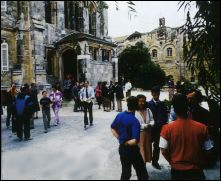
Christ Church, Jerusalem
Christ Church was the first Protestant church to be established in the Middle East. Situated just inside the Jaffa gate of the Old City of Jerusalem, it was consecrated in 1849 and is now home to several congregations. There are international English-speaking congregation (Anglican) services on Sundays and a Hebrew-speaking congregation meeting on Saturdays. Romanian and Filipino congregations also worship there.

Christ Church was the first Protestant church to be established in the Middle East. Situated just inside the Jaffa gate of the Old City of Jerusalem, it was consecrated in 1849 and is now home to several congregations. There are international English-speaking congregation (Anglican) services on Sundays and a Hebrew-speaking congregation meeting on Saturdays. Romanian and Filipino congregations also worship there.
Wednesday, March 17, 2004
Purpose and Vision click here
(this happened last month, around 02/26 or 02/28/04, (shortly after I saw "THE PASSION" movie) it's a prophetic theme worth praying and "contending for", in the spirit!):
GOD WOKE ME UP IN THE MIDDLE OF THE NITE OUT OF A VERY SOUND SLEEP, AND EVEN WHEN I WAS BARELY AWAKE, I FELT HIS OVERWHELMING PRESENCE, STRONGER AND EVEN MORE ENCOMPASSING THAN EVER BEFORE!... LIKE HE WAS PERSONALLY/PHYSICALLY THERE, BREATHING RIGHT IN MY FACE!!!
THEN HE SAID TO ME; "I AM SENDING YOU TO ISRAEL! I HAVE SENT YOU TO ISRAEL MANY TIMES BEFORE;YES, THEY ALL SERVED AN IMMEDIATE PURPOSE, BUT OVERALL, THEY WERE ALL JUST PREPARATION FOR WHAT I AM SENDING YOU TO, NOW! IN THE PAST,I SENT YOU TO LEARN MY HEART FOR MY PEOPLE, AND GIVE OUT MY HEART TO MY PEOPLE! I HAVE ALSO SENT YOU TO LEARN MY HEART FOR MY LAND. NOW--IAM SENDING YOU FOR MY SON!!!---TO GO BEFORE AND PREPARE THE WAY IN THE SPIRIT FOR MY SON, TO ONCE AGAIN, COME ALIVE IN MY LAND!!!
HE IS GOING TO COME ALIVE! IN MY LAND AND BE KNOWN AS ALIVE! BY MY PEOPLE. THEY WILL SEE HIM IN THEIR HEARTS!....THE VEILS ARE COMING OFF!...ITS TIME!... MY SON WILL COME TO MY PEOPLE BEFORE HE COMES FOR THEM!" "I AM SENDING YOU! GO!"
(this happened last month, around 02/26 or 02/28/04, (shortly after I saw "THE PASSION" movie) it's a prophetic theme worth praying and "contending for", in the spirit!):
GOD WOKE ME UP IN THE MIDDLE OF THE NITE OUT OF A VERY SOUND SLEEP, AND EVEN WHEN I WAS BARELY AWAKE, I FELT HIS OVERWHELMING PRESENCE, STRONGER AND EVEN MORE ENCOMPASSING THAN EVER BEFORE!... LIKE HE WAS PERSONALLY/PHYSICALLY THERE, BREATHING RIGHT IN MY FACE!!!
THEN HE SAID TO ME; "I AM SENDING YOU TO ISRAEL! I HAVE SENT YOU TO ISRAEL MANY TIMES BEFORE;YES, THEY ALL SERVED AN IMMEDIATE PURPOSE, BUT OVERALL, THEY WERE ALL JUST PREPARATION FOR WHAT I AM SENDING YOU TO, NOW! IN THE PAST,I SENT YOU TO LEARN MY HEART FOR MY PEOPLE, AND GIVE OUT MY HEART TO MY PEOPLE! I HAVE ALSO SENT YOU TO LEARN MY HEART FOR MY LAND. NOW--IAM SENDING YOU FOR MY SON!!!---TO GO BEFORE AND PREPARE THE WAY IN THE SPIRIT FOR MY SON, TO ONCE AGAIN, COME ALIVE IN MY LAND!!!
HE IS GOING TO COME ALIVE! IN MY LAND AND BE KNOWN AS ALIVE! BY MY PEOPLE. THEY WILL SEE HIM IN THEIR HEARTS!....THE VEILS ARE COMING OFF!...ITS TIME!... MY SON WILL COME TO MY PEOPLE BEFORE HE COMES FOR THEM!" "I AM SENDING YOU! GO!"
Tour Schedule click here
The Life and Times of Jesus the Jew
March 26 - April 7, 2004
Hosted by Art Katz
Saturday, March 27: Arrival to Israel and Transfer to Jerusalem
If time permits, we will visit a Messianic congregation in West Jerusalem before checking into the Christ Church Guest House within the historic Old City. Overnight in Jerusalem.
Sunday, March 28: Our Feet are Standing Within Your Gates, O Jerusalem
We will begin our tour by attending the morning service at Christ Church. This church was built in 1849 to share the Gospel with the Jewish people and incorporates many elements of a synagogue. After lunch, we will walk across the street to David's Citadel Museum to learn about the history of Jerusalem. This museum is situated on the site of the palace of Herod the Great and contains a wealth of models, maps and diagrams that will make the history and geography of Jerusalem come alive. Also, on site are two thousand years of archeological remains.
Monday, March 29: The Way of the Sea
Today we begin our study of the life of Jesus. On the way to the Diaspora Museum in Tel Aviv we stop briefly at the Jesus Brothers at the Latrun Monastery. At the Diaspora Museum we will look at Jewish life outside the Holy Land during two thousand years of exile. Finally on to Caesarea on the coast of the Mediterranean Sea where we visit the site of the Jewish insurrection which precipitated the eventual destruction of Jerusalem in 70 A.D. It was also in this Herodian city that the Holy Spirit was first poured out on the Gentiles. After lunch we will go to our hotel for a much needed rest. Overnight in Netanya or nearby.
Tuesday, March 30: The Spirit of the Lord is Upon Me
Our day begins with a stop at Mount Carmel where the encounter between Elijah and the Prophets is thought to have taken place. From this vantage point we can see both the Mediterranean and the beautiful Jezreel Valley. Here we will review the numerous Biblical events that took place in the valley below. At nearby Megiddo (New Testament Armageddon) we visit the ancient Biblical remains and discuss the role of Bible prophecy in the Church today. We will then travel into Lower Galilee to Nazareth, the boyhood town of Jesus. There we will see the Basilica of the Annunciation which sits over the site of Mary's home. Under the church are the actual remains of New Testament Nazareth that will enable to better understand how Jesus and his family lived. Overnight along the Sea of Galilee
Wednesday, March 31: The People Walking in Darkness
Our focus today will the life and activities of Jesus along the Sea of Galilee. We begin with the lakeside village of Capernaum which served as Jesus' home during much of his public ministry. At the Tabgha Church we recall Jesus' restoration of fellowship with Peter after his resurrection. Here a time of quiet and meditation will be provided. In the same area we will recall how Jesus feed the five thousand. The Sermon on the Mount will be our focus when we stop at the Mount of Beatitudes. After visiting the church and discussing Jesus' teaching, we will take a gentle walk in the Galilean countryside. In the afternoon we take a boat ride across the Sea of Galilee. Afterwards, there will be free time in Tiberias or possibly a visit to a nearby religious kibbutz. Overnight along the Sea of Galilee
Thursday, April 1: Who Do Men Say That I Am?
We explore the Upper Galilee and Golan Heights today in order to retrace the journey of Jesus to the regions of Caesarea Philippi (Banias) which is a significant turning point in his ministry. It was here that Peter confesses Jesus to be the Messiah and where Jesus for the first time openly talks of going to Jerusalem to suffer and die. Not long afterwards, Jesus is transfigured (most likely on Mount Hermon). To better understand these events, we will visit the ruins of Caesarea Philippi at Banias and the spring complex at Dan. On our way back to the Sea of Galilee we will ascend onto the lower slopes of Mount Hermon, and if time permits, we will stop at a restored Jewish village of Katzrin to get a first hand view of daily life in the First Century. Overnight along the Sea of Galilee
Friday, April 2: The Ax is at the Root
We return to Jerusalem via the Jordan Valley. As we go, we will stop at various sites in the Jordan Valley, such as the Jordan River, Jericho, and Qumran, where we will discuss the life and ministry of John the Baptist - looking at his understanding of Messiah, judgment and the role of the Holy Spirit. In the Jericho area we will compare John's views with those of Jesus. At the end of the day (conditions permitting) we will stop in Bethany on the Mount of Olives – the town where Jesus raised Lazarus from the dead. Overnight Jerusalem.
Saturday, April 3: Sabbath Rest Day
Free morning in Jerusalem. Time for shopping or visiting those sights not included on the itinerary. In the afternoon we will go to Jaffa to visit a Messianic congregation and view Tel Aviv at night.
Sunday, April 4: A Place Where I Will Put My Name
Jerusalem in the Time of Jesus (Jewish Quarter, Western Wall, Temple Mount). Today we examine the city of Jerusalem as it existed in the times of Jesus. After a late start, the Temple Mount will be our focus as we attempt to visually reconstruct how the area would have looked during the time of Solomon and Jesus. Afterwards we will examine the Herodian remains uncovered at the foot of the Temple Mount. Here we will stand on the stairs that allowed access onto the Temple Mount. It was these very stairs that Jesus himself would have used. Time will be given to visit the Western (Wailing) Wall and before dinner there will be a short tour in the Ultra-orthodox neighborhood of Mea Shearim.
Monday, April 5: (Erev Pessach) For if They Do These Things in the Green Tree, What Will Happen in the Dry?
This morning we visit Yad Vashem, the museum/memorial to the Holocaust - the mass industrialized murder of six million Jews. Next, our attention will be directed to the last week of the life of Jesus. At the Garden of Gethsemane we will consider the arrest of Jesus by the Sadducees and his struggle with doing God's will. Crossing the Kidron valley we make our way up to the Via Dolorosa, the traditional way of the Cross. Entering through the Lions Gate we will stop and consider crucifixion and the Cross of Jesus in its Jewish context. Evening Passover Meal.
Tuesday, April 6: Why Do You Seek the Living One Among the Dead?
On the Mount of Olives we retrace Jesus' triumphal entry into the city. As we walk down the Mount of Olives and stop briefly at the Church of Dominus Flevit, we will recall Jesus' warning to Jerusalem. Here we also learn about Jewish burial practices in the First Century and examine graves from that period. In the Church of the Holy Sepulchre we will discuss the resurrection as a "Jewish faith experience.” Our tour concludes with a guided tour of the Garden Tomb and communion. Late afternoon is free for packing or last minute shopping. Evening: Open House at Christ Church.
The Life and Times of Jesus the Jew
March 26 - April 7, 2004
Hosted by Art Katz
Saturday, March 27: Arrival to Israel and Transfer to Jerusalem
If time permits, we will visit a Messianic congregation in West Jerusalem before checking into the Christ Church Guest House within the historic Old City. Overnight in Jerusalem.
Sunday, March 28: Our Feet are Standing Within Your Gates, O Jerusalem
We will begin our tour by attending the morning service at Christ Church. This church was built in 1849 to share the Gospel with the Jewish people and incorporates many elements of a synagogue. After lunch, we will walk across the street to David's Citadel Museum to learn about the history of Jerusalem. This museum is situated on the site of the palace of Herod the Great and contains a wealth of models, maps and diagrams that will make the history and geography of Jerusalem come alive. Also, on site are two thousand years of archeological remains.
Monday, March 29: The Way of the Sea
Today we begin our study of the life of Jesus. On the way to the Diaspora Museum in Tel Aviv we stop briefly at the Jesus Brothers at the Latrun Monastery. At the Diaspora Museum we will look at Jewish life outside the Holy Land during two thousand years of exile. Finally on to Caesarea on the coast of the Mediterranean Sea where we visit the site of the Jewish insurrection which precipitated the eventual destruction of Jerusalem in 70 A.D. It was also in this Herodian city that the Holy Spirit was first poured out on the Gentiles. After lunch we will go to our hotel for a much needed rest. Overnight in Netanya or nearby.
Tuesday, March 30: The Spirit of the Lord is Upon Me
Our day begins with a stop at Mount Carmel where the encounter between Elijah and the Prophets is thought to have taken place. From this vantage point we can see both the Mediterranean and the beautiful Jezreel Valley. Here we will review the numerous Biblical events that took place in the valley below. At nearby Megiddo (New Testament Armageddon) we visit the ancient Biblical remains and discuss the role of Bible prophecy in the Church today. We will then travel into Lower Galilee to Nazareth, the boyhood town of Jesus. There we will see the Basilica of the Annunciation which sits over the site of Mary's home. Under the church are the actual remains of New Testament Nazareth that will enable to better understand how Jesus and his family lived. Overnight along the Sea of Galilee
Wednesday, March 31: The People Walking in Darkness
Our focus today will the life and activities of Jesus along the Sea of Galilee. We begin with the lakeside village of Capernaum which served as Jesus' home during much of his public ministry. At the Tabgha Church we recall Jesus' restoration of fellowship with Peter after his resurrection. Here a time of quiet and meditation will be provided. In the same area we will recall how Jesus feed the five thousand. The Sermon on the Mount will be our focus when we stop at the Mount of Beatitudes. After visiting the church and discussing Jesus' teaching, we will take a gentle walk in the Galilean countryside. In the afternoon we take a boat ride across the Sea of Galilee. Afterwards, there will be free time in Tiberias or possibly a visit to a nearby religious kibbutz. Overnight along the Sea of Galilee
Thursday, April 1: Who Do Men Say That I Am?
We explore the Upper Galilee and Golan Heights today in order to retrace the journey of Jesus to the regions of Caesarea Philippi (Banias) which is a significant turning point in his ministry. It was here that Peter confesses Jesus to be the Messiah and where Jesus for the first time openly talks of going to Jerusalem to suffer and die. Not long afterwards, Jesus is transfigured (most likely on Mount Hermon). To better understand these events, we will visit the ruins of Caesarea Philippi at Banias and the spring complex at Dan. On our way back to the Sea of Galilee we will ascend onto the lower slopes of Mount Hermon, and if time permits, we will stop at a restored Jewish village of Katzrin to get a first hand view of daily life in the First Century. Overnight along the Sea of Galilee
Friday, April 2: The Ax is at the Root
We return to Jerusalem via the Jordan Valley. As we go, we will stop at various sites in the Jordan Valley, such as the Jordan River, Jericho, and Qumran, where we will discuss the life and ministry of John the Baptist - looking at his understanding of Messiah, judgment and the role of the Holy Spirit. In the Jericho area we will compare John's views with those of Jesus. At the end of the day (conditions permitting) we will stop in Bethany on the Mount of Olives – the town where Jesus raised Lazarus from the dead. Overnight Jerusalem.
Saturday, April 3: Sabbath Rest Day
Free morning in Jerusalem. Time for shopping or visiting those sights not included on the itinerary. In the afternoon we will go to Jaffa to visit a Messianic congregation and view Tel Aviv at night.
Sunday, April 4: A Place Where I Will Put My Name
Jerusalem in the Time of Jesus (Jewish Quarter, Western Wall, Temple Mount). Today we examine the city of Jerusalem as it existed in the times of Jesus. After a late start, the Temple Mount will be our focus as we attempt to visually reconstruct how the area would have looked during the time of Solomon and Jesus. Afterwards we will examine the Herodian remains uncovered at the foot of the Temple Mount. Here we will stand on the stairs that allowed access onto the Temple Mount. It was these very stairs that Jesus himself would have used. Time will be given to visit the Western (Wailing) Wall and before dinner there will be a short tour in the Ultra-orthodox neighborhood of Mea Shearim.
Monday, April 5: (Erev Pessach) For if They Do These Things in the Green Tree, What Will Happen in the Dry?
This morning we visit Yad Vashem, the museum/memorial to the Holocaust - the mass industrialized murder of six million Jews. Next, our attention will be directed to the last week of the life of Jesus. At the Garden of Gethsemane we will consider the arrest of Jesus by the Sadducees and his struggle with doing God's will. Crossing the Kidron valley we make our way up to the Via Dolorosa, the traditional way of the Cross. Entering through the Lions Gate we will stop and consider crucifixion and the Cross of Jesus in its Jewish context. Evening Passover Meal.
Tuesday, April 6: Why Do You Seek the Living One Among the Dead?
On the Mount of Olives we retrace Jesus' triumphal entry into the city. As we walk down the Mount of Olives and stop briefly at the Church of Dominus Flevit, we will recall Jesus' warning to Jerusalem. Here we also learn about Jewish burial practices in the First Century and examine graves from that period. In the Church of the Holy Sepulchre we will discuss the resurrection as a "Jewish faith experience.” Our tour concludes with a guided tour of the Garden Tomb and communion. Late afternoon is free for packing or last minute shopping. Evening: Open House at Christ Church.
